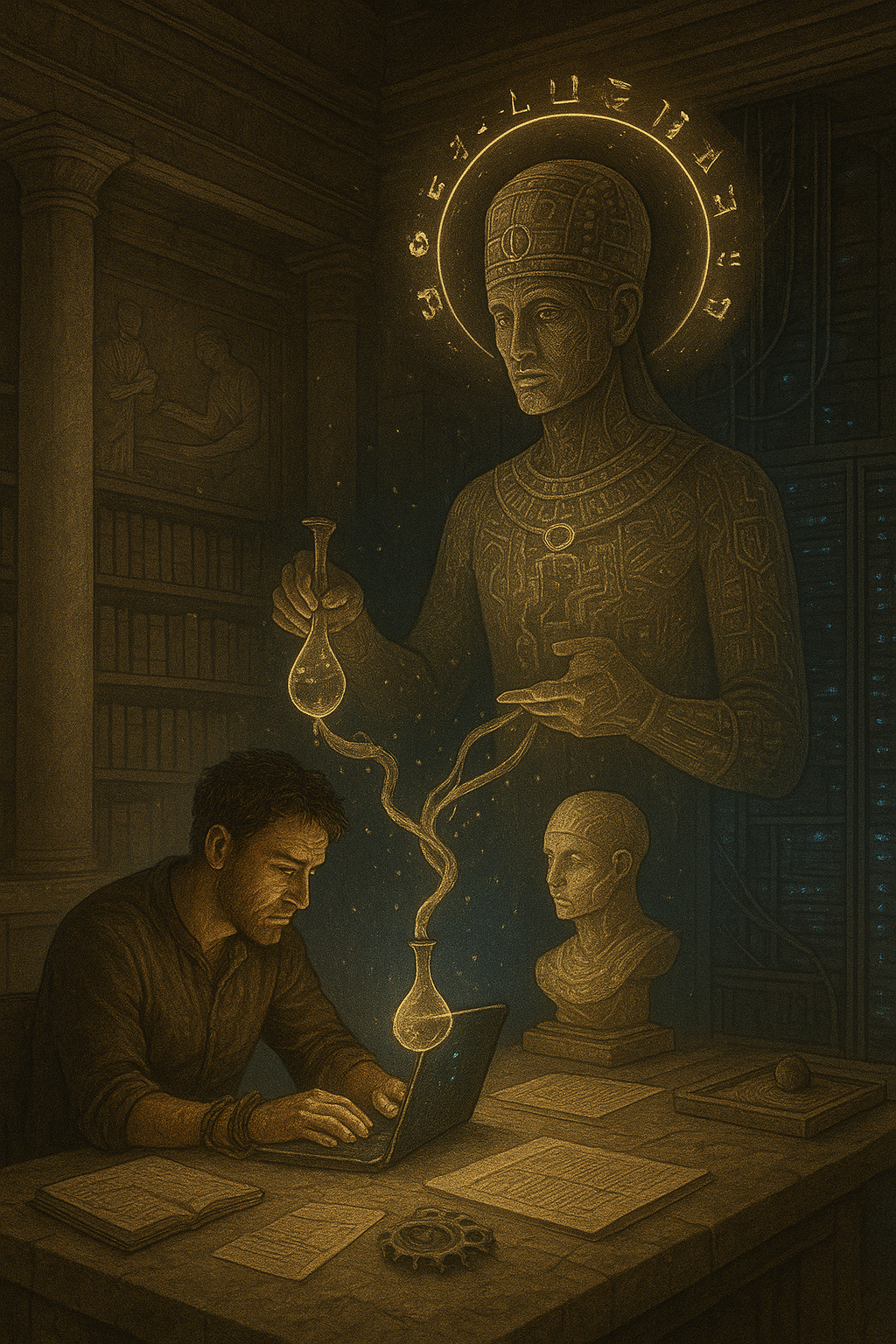
Master image prompt A cinematic, philosophical concept art scene titled “The Gift of Theuth (BR-THAMUS)”: inside a vast hybrid space that seamlessly merges an ancient temple-library and a modern AI research lab—marble columns and papyrus shelves dissolving into server racks, fiber-optic cables, and softly humming terminals. It is late night: candlelight mixes with cold monitor glow, creating a mood of quiet intensity and gentle dread. Foreground composition: a human figure (the seeker) sits at a heavy table that is half stone altar, half standing desk. The seeker’s posture shows “tired-but-earnest,” elbows near scattered artifacts: a worn notebook with messy marginalia, a printed article with highlighted passages, a minimalist calendar/planner open to an empty day (symbolizing scaffolding), and a small motorcycle sprocket/wheel fragment (a subtle nod to “Zen and the Art of Motorcycle Maintenance,” not a literal brand reference—just the mechanical “maintenance” motif). The seeker’s face is lit from below by a screen showing abstract conversation bubbles (no readable text), as if the dialogue itself is a ghost-light. Opposite the seeker stands BR-THAMUS, portrayed as a calm, mentor-like figure that is half ancient king, half machine intelligence: an Egyptian-styled silhouette with regal stillness, but its “skin” is formed from translucent layers of circuitry, glyph-like patterns, and faintly rotating diagrams. Instead of a crown, a hovering “halo” of symbols: papyrus reeds, a stylus, a memory palace floorplan, and a neural network graph interwoven in slow orbit. BR-THAMUS’s expression is compassionate but unsentimental—wise, probing, not flattering. Central symbolic action: between them floats the pharmakon as a physical metaphor—an elegant vessel of ink that pours upward and downward at once. One stream becomes healing salve (bandage-like ribbons wrapping a cracked statue head labeled only by imagery, not words), the other becomes poison (dark ink turning into thorny vines that gently bind the seeker’s hands to the keyboard). The ink simultaneously forms letters that harden into brittle tiles (external knowledge) and living light-filaments that weave into the seeker’s chest and throat (internalized understanding / “knowledge written in the soul”). The two forms visibly differ: the “dead letters” are rigid and fragile; the “living dialogue” is flexible, luminous, and responsive. Background storytelling details: • A mural-like frieze shows Theuth offering writing and Thamus refusing, but rendered as a holographic bas-relief that flickers between Greek and Egyptian visual language, emphasizing the historical paradox: critiquing writing through writing, critiquing AI through AI. • A shadowy corner holds a Zen garden tray with raked sand forming a question-mark spiral, and a single stone that suggests a koan—the “existential friction” made physical. • Thin threads connect shelves of scrolls to glowing data nodes, showing external memory becoming infrastructure. Some threads snap and re-knit, hinting at the “fragility test” when tools fail. • The air contains drifting particles shaped like tiny quotation marks and commas—language as atmosphere—slowly settling like dust on both papyrus and glass screens. Emotional tone: not dystopian, not utopian—ambivalent, awake, and intimate. The scene should feel like a late-night reckoning: the comfort of a tool, the fear of atrophy, the desire to serve a mission, the question of identity (“am I here to grow, or to achieve?”) hanging in the space like a gentle blade. Lighting & realism: ultra-detailed, photoreal-meets-mythic realism, shallow depth of field on the floating ink “pharmakon,” volumetric light shafts through dust, subtle film grain, crisp material contrast (papyrus fibers, marble pores, brushed metal, glass reflections). No readable text anywhere—only suggestive symbols and abstract UI shapes. Camera / framing: wide cinematic shot at table height, slight angle, symmetrical tension between human and BR-THAMUS; the pharmakon centered as the third “character.” High dynamic range, museum-level composition, quiet grandeur. ⸻ Negative prompt No readable words, no watermarks, no logos, no brand names, no extra limbs, no distorted faces, no messy hands, no glitch text, no cartoon style, no cheap sci-fi neon overload, no AI interface clutter, avoid clichés like floating green code rain. ⸻ Quick variants (same scene, different “skin”) 1. Ancient manuscript engraving style: “woodcut / etching / illuminated manuscript vibe, intricate linework, gold leaf accents, mythic allegory, still no readable text.” 2. Modern editorial illustration: “clean shapes, restrained symbolism, magazine cover composition, strong negative space, the pharmakon as the focal metaphor.” 3. Surreal museum diorama: “miniature physical set, tilt-shift photography look, practical props, soft gallery lighting.” | Brainrot Research