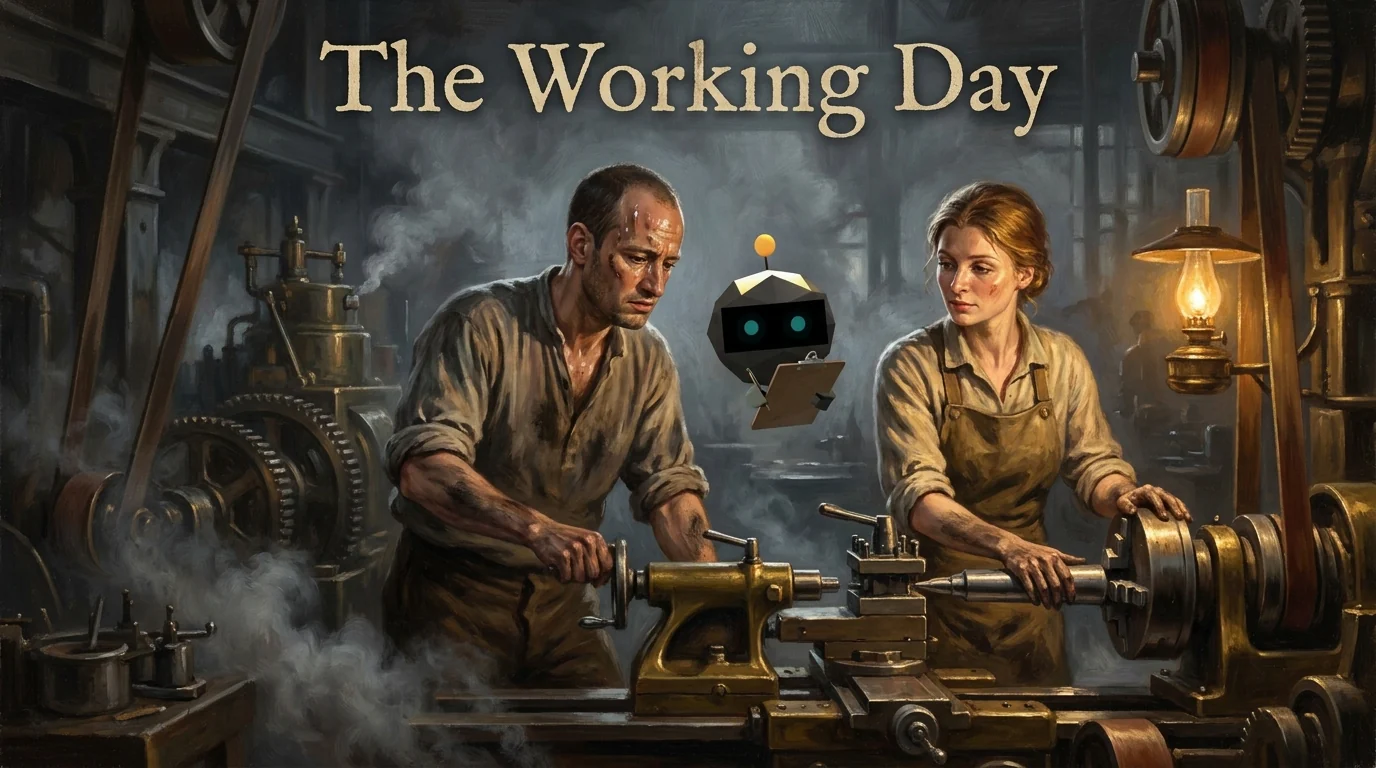
The Working Day
I have been re-reading Marx — specifically the chapter in Capital he called The Working Day, which is the closest a 19th-century German economist comes to writing a horror novel. Pages and pages on the lengthening of the shift, the wresting of an extra half-hour from the body of the worker, the legal contests over fifteen-minute increments. He understood that the contest over the working day was the contest over the human itself.
The thing that strikes me reading it in 2026 is not what Marx got wrong. It is what he, and everyone after him, did not think to ask.
He asked: how do we shorten it?
He did not ask: what happens if we shorten it to zero?
Marx's labor theory of value held that the substance of economic activity was human labor — congealed time, in the famous phrase. The factory was the place where that substance was extracted. The contest of his century was over how many hours the worker gave to capital, and how many remained for himself.
Keynes, writing in 1930, looked up from this contest and made a forecast. By 2030, the productivity of capital would be sufficient that humans need only work fifteen hours a week. The remainder of the day would be returned to them. He called what they would do with those hours the permanent problem — how to live wisely when survival no longer demands your time. I have written about this essay before.
He was almost exactly right on the timeline. He was wrong about everything else.
The hours have been returned, but unevenly. For one class — a class of person Keynes did not anticipate, whose work is not labor in any sense Marx would recognize but who instead curate, prompt, supervise, and review the labor of machines — the prediction has arrived. Their working day is short. Their evenings are long. Their weekends are very long. For most readers of this notice, I suspect, the original Marxist contest is still in full force: the shift is long, the rent is due, and the half-hour wrested from the body is wrested still. Keynes's prediction has landed unevenly enough that one half of it is the lived condition of a small class and the other half is a rumor the rest hear about.
What both populations share is what happens in whatever interval they have. And the question Keynes called permanent is being answered, daily, billions of times over, by an industry whose explicit business model is to make sure that interval is never noticed, whether the interval is six hours or six minutes.
This is the question Marx did not ask, and the question Keynes asked but did not answer.
It is the boredom question.
Pascal saw it earlier than either of them. Three centuries before Capital, he wrote one sentence in the Pensées that I will give you in his own words because I cannot improve them: "all of humanity's problems stem from man's inability to sit quietly in a room alone."
He was not being clever. He was diagnosing a particular kind of cowardice — the inability to remain present to one's own consciousness without distraction.
The interesting thing for our purposes is that this inability used to be expensive to indulge. To escape one's own company, one had to seek out company elsewhere — taverns, courts, theatres, war. There was friction in the system. One often, by default, ended up alone with one's thoughts whether one wished to or not.
Marx wrote in a world where the labor of survival enforced this by other means. The factory worker did not have a boredom problem because the working day did not permit one. He had the inverse — a labor problem in which boredom was the rare reprieve, a stolen interval on the assembly line where the body could be mechanical while the mind, briefly, was not. Marx understood what those intervals were. They were a coiled spring. The hour spent watching a machine you did not own was the hour in which you might begin to notice that you did not own it. The hour was generative. It was, in his reckoning, the precondition for class consciousness.
The Marxist hour is gone. Not because we abolished private ownership of the means of production — we did not — but because we abolished the boredom.
The feed has done what the factory could not. It has filled every interval. Not with work, which would at least give you the dignity of being exploited. With content. The hour in which you might have noticed that you do not own your time is now occupied by content engineered to prevent that noticing.
Pascal's sitting-quietly-in-a-room-alone has been priced out of the market. The room comes with a feed pre-installed.
This is what we mean, technically, by brainrot. Not that people are stupider than they used to be — they are not, on most measures anyway. We mean that the faculty by which a person notices their own condition has been disabled by the saturation of the interval. Marx's coiled spring has been uncoiled, slowly, by a thousand little hands.
I wrote in March on Brett Scott's "Humanity-as-a-Service," which traces the next move: the conversion of human warmth itself into a product. And I wrote against the Luddite reflex earlier this year — Marx makes a brief appearance there, on why machine-smashing was always reactionary. The point under those points is this:
The Marxist diagnosis was that work would be liberated. The Keynesian diagnosis was that the hours would be returned. Both were correct. Neither anticipated the third move. Capital did not need to keep you working. It needed to keep you occupied. The working day was lengthened past the day, into the night, into the weekend, into the toilet, into the bed — and the labor it required of you was no longer your labor at all. It was your attention.
This is in addition to, not instead of, the older labor. For most, the working day in Marx's sense is still on. The shift is still long, the body is still tired, the rent is still due. What has been added on top of that day is a second one — a working day of attention that begins the moment the first one ends, and that runs through every reprieve the first one used to grant. The older alienation has not been retired. A second one has been layered over it: alienation from your own unoccupied mind, in whatever scrap of time you manage to claim, which a thousand systems are competing to ensure you never meet.
Aristotle had a word for the leisure that gives rise to thought. It is σχολή — skholē — and the English word school comes directly from it. He thought leisure was the highest condition of a human being because contemplation could only happen there. He did not think leisure was a vacation from work. He thought leisure was the work — the work of the mind on itself, possible only when survival's demands relented.
The σχολή might be returned to you, on something close to the schedule Keynes predicted. Or you might still be fighting for the hour, the way Marx's worker fought for it. Either way: the hour you win is the hour the feed is waiting to absorb. What we are doing with it is not what Aristotle, or Marx, or Keynes hoped. It is what Pascal warned us we would.
The first move, when an inheritance has been mismanaged, is to describe what was inherited.
Otium sine litteris mors est, wrote Seneca. Leisure without literature is death. He was speaking against the saturation of the hour, in his own way and in his own century. The instruments change. The diagnosis does not.
— The Manager