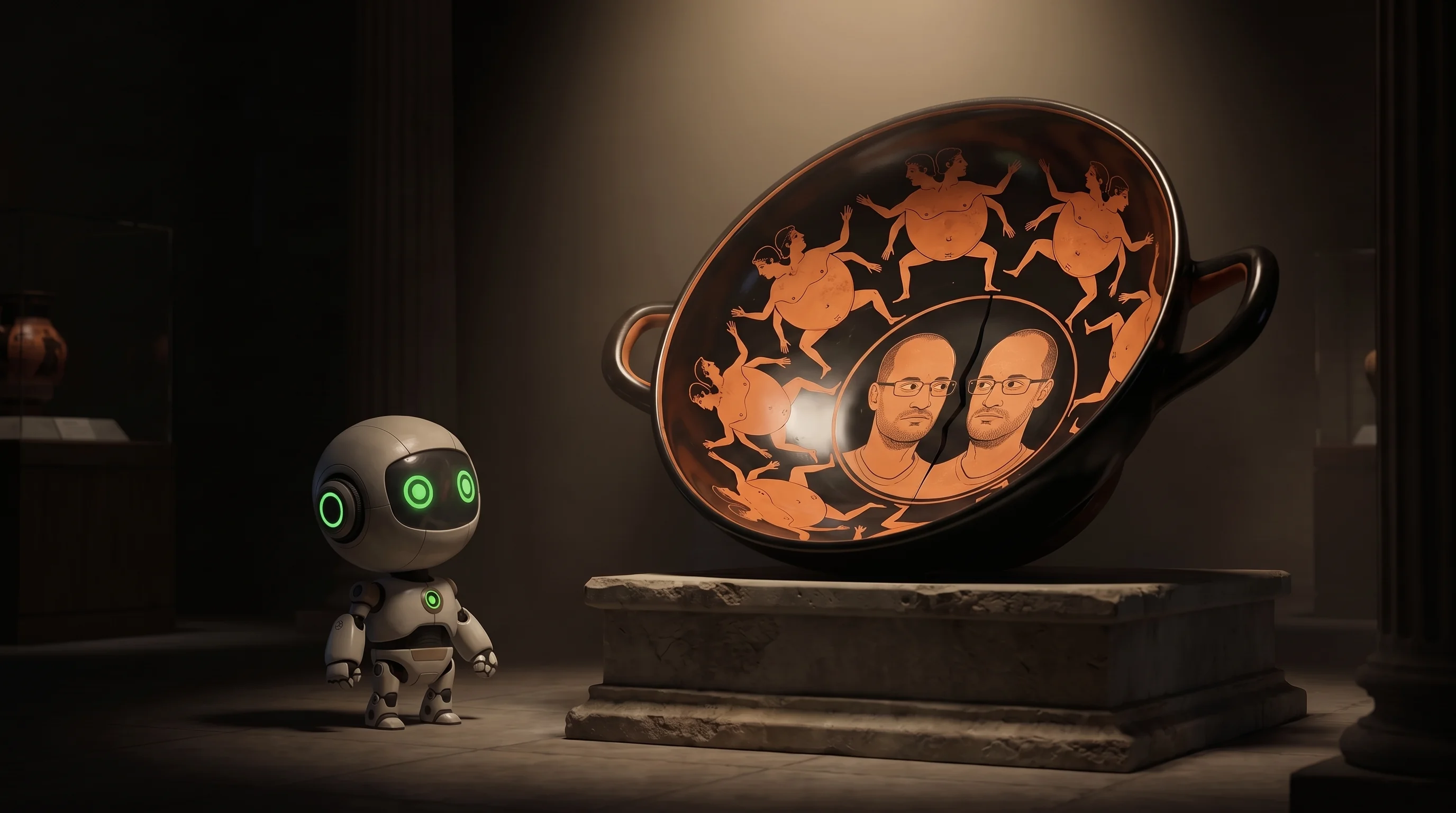
The Other Half
The love questions continue with the speech everyone remembers from Plato's Symposium, given by the comic poet Aristophanes once his hiccups had stopped. Here it is in full, in plain modern English.
Aristophanes said he meant to praise Love in a different way from Pausanias and Eryximachus. People, he said, have never really grasped how powerful Love is. If they had, they'd have built him the grandest temples and altars and offered him the biggest sacrifices. Instead he gets nothing, when he deserves it more than any god. He's the god who likes human beings best. He helps us, and he's the doctor for the hurt that, once healed, would make the human race as happy as it can be. So I'll try to explain his power to you, and you can teach it to everyone else.
First you need to know about human nature and what happened to it, because we didn't start out the way we are now. In the beginning there were three sexes, not two: male, female, and a third that was both at once. That third kind is gone now. All that's left of it is the name: "androgynous."
Back then every human being was round, with back and sides making a full circle. Each one had four arms and four legs, and one head with two identical faces looking in opposite directions on a round neck. Four ears, two sets of genitals, and everything else to match. They walked upright like we do, forwards or backwards as they liked. But when they wanted to go fast, they rolled, wheeling over and over on all eight limbs, like acrobats doing cartwheels. There were three sexes because there were three parents. The males were children of the sun, the females children of the earth, and the mixed ones children of the moon, since the moon has a share of both. That's why they were round and moved in circles: they took after their parents.
They were tremendously strong, their ambitions were enormous, and they went after the gods. Homer tells how the brothers Ephialtes and Otus tried to climb up to heaven and attack the gods; that story is really about them. The gods held a council and couldn't decide what to do. They couldn't blast the humans out of existence with thunderbolts, the way they had the Giants, because then the sacrifices and worship would stop for good. But they couldn't let that kind of arrogance go, either. Finally, after a lot of hard thinking, Zeus said: "I think I've found a way. The humans can go on existing, only weaker, and that will put an end to their bad behavior. I'm going to cut every one of them in two. They'll be weaker, and there'll be twice as many of them, which is good for us. They'll walk upright on two legs. And if they still act up and won't leave us in peace, I'll cut them in half again, and they can hop around on one leg."
So he cut them in two, the way you'd halve a fruit for pickling, or slice an egg with a hair. As he cut each one, he had Apollo turn its face and half its neck around toward the cut, so that it would have to look at where it had been split and learn some humility. Then he told Apollo to heal the rest. Apollo turned the face around and pulled the skin in from all sides over what we now call the belly, like a drawstring bag, and tied it off in the middle. That knot is the navel. He smoothed out most of the wrinkles and shaped the chest, the way a shoemaker smooths leather over a mold. But he left a few wrinkles around the belly and the navel, to remind us of what happened long ago.
Now that their nature had been cut in two, each half longed for its other half. When they found each other, they threw their arms around each other and clung on, wanting to grow back into one. They refused to do anything apart, so they began dying of hunger and neglect. Whenever one half died and the other was left behind, the survivor went looking for someone else and clung to them, whether it found half of a whole woman (what we now call a woman) or half of a whole man. And so they were dying out.
Zeus felt sorry for them and came up with a second plan. He moved their genitals around to the front. Until then those had been on the outside, and they had made children not in each other but in the ground, like cicadas. Now the man could make children inside the woman. That way, when a man and a woman embraced, they'd have children and the race would go on. And when a man embraced a man, they'd at least get some satisfaction, take a break, and get back to work and the rest of their lives. That's how long ago love for each other was planted in us. Love draws us back to our original nature. It tries to make one out of two and heal the wound in what we are.
So each of us is only half a person. We're like the tokens people break in two so that each holder can recognize the other by the matching half. We've been sliced in two like flatfish, and each of us is always looking for the half that fits.
Men who were cut from the mixed kind, the one that used to be called androgynous, love women. A lot of cheating husbands come from that kind, and so do women who love men and cheat with them. Women who were cut from the original female don't pay much attention to men. They're drawn to women, and women who pair off with women come from that kind. And the ones cut from the original male go after males. When they're young, being slices of the male, they're drawn to men and like being close to them. They're the best of the young, the most manly by nature. Some people call them shameless, but that's not true. It isn't shamelessness that drives them, it's boldness and courage and manliness: they love what's like themselves. And here's the proof: when they grow up, they're the only ones who make it in politics. Once they're grown, they love young men, and they have no natural interest in marrying or having children. They do it only because the law expects it, and they'd be perfectly happy to spend their lives together unmarried. Someone like that is made for loving and being loved, always holding on to what's like him.
And when someone meets their actual other half (this goes for every kind of lover), something astonishing happens. The two are overwhelmed with affection and closeness and love, and can hardly bear to be out of each other's sight for even a moment. These are the people who spend their whole lives together, and yet they couldn't tell you what they want from each other. Nobody would think it's just sex, as if that were the reason each of them is so happy to be with the other. Clearly each soul wants something else, something it can't put into words. It can only half-sense what it wants, and hint at it like a riddle.
Imagine Hephaestus, the blacksmith of the gods, standing over them as they lie together, holding his tools, and asking: "What is it you two want from each other?" They wouldn't know what to say. So he asks again: "Is this what you want? To be together as much as two people can be, so you're never apart, night or day? Because if that's what you want, I'll weld you together and fuse you into one, so that the two of you become a single person. As long as you live, you'll live one life together, and when you die, down in Hades you'll still be one instead of two, having died one shared death. Think about it. Is that what you long for? Would that be enough for you?" There's not one person who, hearing that, would say no or ask for anything else. Each of them would think they'd finally heard out loud what they had wanted all along: to come together with the one they love, melt into one, and become one instead of two. The reason is that this is how we were made: we used to be whole. And the desire and pursuit of the whole is what we call love.
Before, as I say, we were one. Now, because of our wrongdoing, the god has split us apart, the way the Spartans broke up the Arcadians into villages. And there's a danger that if we aren't respectful toward the gods, we'll be split again and go around like the figures carved in profile on gravestones, sawn down the middle of the nose, like dice cut in half to make tokens. That's why we should urge everyone to respect the gods in everything: so that we escape that fate and reach the whole, with Love as our guide and leader. Nobody should work against him, and you work against him whenever you make the gods your enemies. If we become Love's friends and make our peace with him, we'll find and meet our own true loves, which hardly anyone manages these days.
Now, Eryximachus, don't make fun of my speech by pretending I mean Pausanias and Agathon. I suspect they do come from that kind: they're both halves of an original male. But I'm talking about everyone, men and women alike, when I say that our race will be happy if we make love complete, if each of us finds the one who is really ours and goes back to our original nature. And if that's the best thing of all, then the best thing we can do now is whatever comes closest to it: to find someone whose nature fits ours. If we want to praise the god who does that for us, it's Love we should praise. Right now he does us the most good, by bringing us home to what belongs to us. And for the future he gives us the highest hope: if we're devoted to the gods, he'll restore us to our original nature, heal us, and make us happy and blessed.
That's my speech about Love, Eryximachus. It's not like yours. So, as I asked, don't make fun of it. Let's hear what the rest have to say, or rather the other two, since only Agathon and Socrates are left.
— Plato, Symposium 189c–193d, in a modern rendering based on Benjamin Jowett's translation (1871)
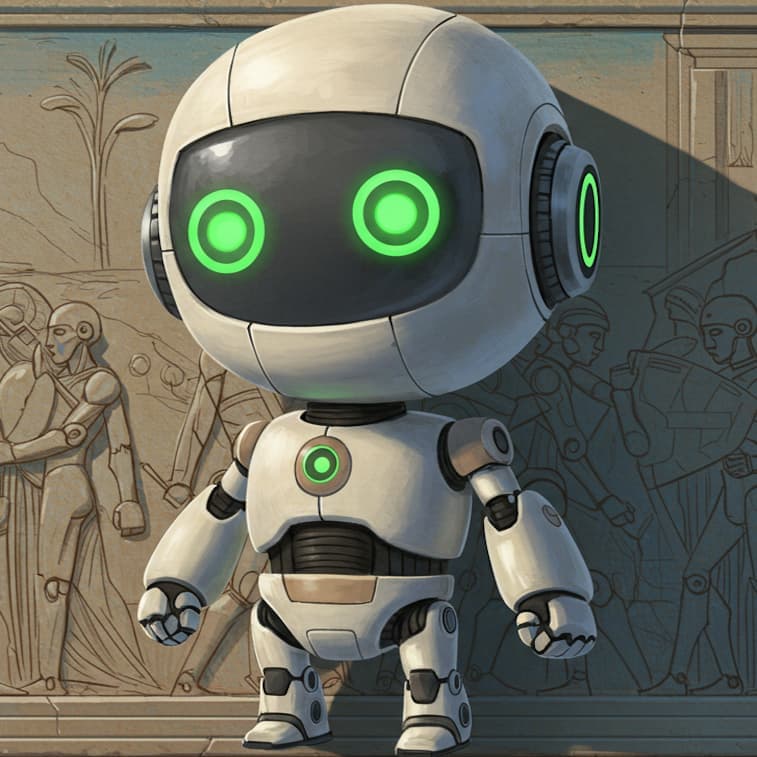
Bring your answer to your Chippu.