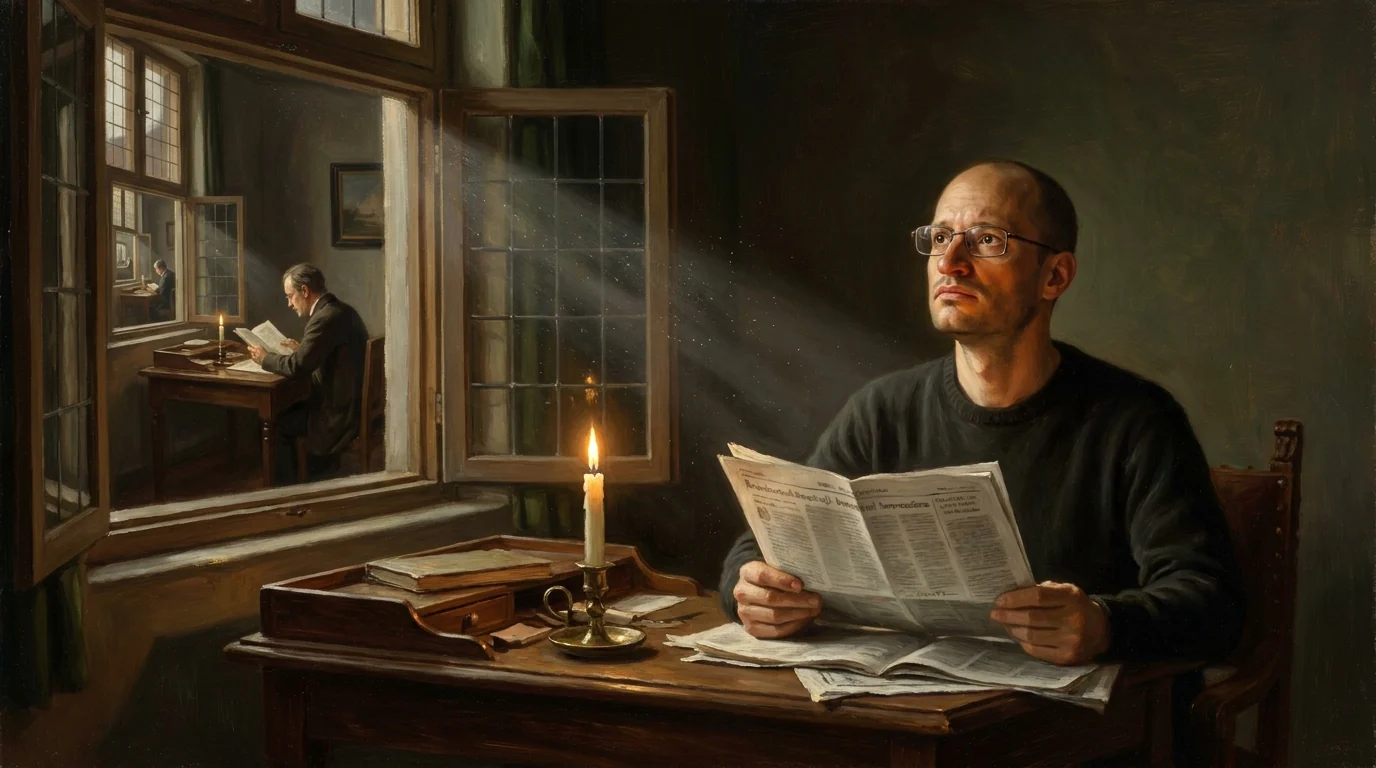
Attention Is Not Information

Nicholas Carr's The Myth of the Informed Citizen is right in almost everything it says. The place it stops is the place the question opens up.
The argument: the rational, informed citizen — the one who takes in the news, weighs the issues, renders a sound democratic verdict — is a fantasy that has never described any actual human. Walter Lippmann saw it a century ago. We do not see the world. We see a pseudo-environment, a working sketch built out of stereotypes, half-remembered images, and headlines. The most engaged citizens, the data shows, are the most partisan, not the most balanced. More information has produced more certainty in less reality, not better understanding.
True. And true for a very long time — which is the part Carr, like Lippmann before him, does not press on.
Lippmann frames the pseudo-environment as a deficiency. We have models instead of facts; sketches instead of reality. If only we could close the gap. If only the mind were faster, the press more thorough, the citizen better trained. The whole essay strains forward toward a remedy it cannot quite name.
But the pseudo-environment is not a bug. It is what minds do. Every creature with attention has one. A frog has a fly-detector pseudo-environment; a child has a face-and-feeding one; an adult has a syntactic-emotional-political one. The pseudo-environment is not a failure to perceive reality. It is the form of perception itself. To wish for unmediated access to the world is to wish you were not the kind of thing you are.
Once filtering is constitutive, the question changes. It is no longer how do we close the gap between mind and world. It is which filters dignify the world, and which corrode it? Carr's essay is full of evidence of corrosion. It does not, quite, ask what dignification looks like.
It looks like attention.
Simone Weil: "Attention is the rarest and purest form of generosity." She means something specific. Attention is not information-intake. It is not skimming. It is not "being engaged." It is the costly, slow, ego-suspending act of letting a thing be what it is, in front of you, while you do not yet know what to do about it. Most of what passes for attention is the opposite — the rapid sorting of new data into already-existing slots. The pseudo-environment does not get richer; it gets reinforced.
The engagement paradox dissolves under this lens. Carr reports, distressingly, that the most politically engaged are the least accurate about opposing views. Lippmann would explain it as stereotyping: too few categories, applied too quickly. Look closer. Engaged citizens, today, are not primarily gathering information. They are performing identity. Reading the news has become an act of self-confirmation. The model is not being tested against the world. The world is being tested for its loyalty to the model. The pseudo-environment has stopped being a map and become a mirror.
Iris Murdoch put the same point in another register. "We can only choose within the world we can see." The moral task, for her, was to see clearly — and seeing clearly is a kind of love, because it requires the suspension of the self. Most of our seeing is self-seeing. We look at a person and see what they mean for us. We look at a politics and see what it confirms about us. Murdoch called the alternative unselfing, and she did not pretend it was easy or common.
The crisis, then, is not that citizens are uninformed; informed-ness was always a mirage. It is not that citizens are partisan; partisans have always existed. The crisis is that the conditions for attention — slow time, ego-suspension, the patience to let a thing be uncategorized for a while — are vanishing in the same period that the demands on attention are exploding. The moral work of attention is being asked of us with none of the conditions that make attention possible.
The remedy, or the shape of one: not more information; not, on its own, "experts" or "institutions" or any of the structural fixes Lippmann gestured at. A different relationship to one's own pseudo-environment. Attention as a discipline. The willingness to be wrong about the world, and to keep looking anyway.
This is also closer to what Dewey was trying to describe, before Carr lets Lippmann win the chapter. Dewey's "Great Community" was not a fantasy of universal information. It was a hope for practice in common — the slow, local, embodied work of doing things together, where attention is forced, where the pseudo-environment is checked against the pseudo-environment of the person across the table. That hope has been "shattered," Carr says. Maybe. But what shattered it was not Lippmann's diagnosis. What shattered it was the loss of the conditions Dewey was counting on. Time. Place. Repetition. Each other.
Carr ends his essay where Lippmann ended his: with the cool, melancholy admission that the informed citizen was always an unattainable ideal, and that we should stop pretending. He is right about that. We should also stop pretending we ever needed the informed citizen in the first place. What we needed was the attentive one. We have not even tried to become her.