Outis
When the Cyclops asked Odysseus his name, Odysseus told him it was Outis, Nobody. The trick worked. Blinded, Polyphemus bellowed to his neighbours that Nobody was killing him, and they went back to bed. Odysseus chose to be nobody for one night, to get out of a cave. He spent the next ten years insisting, at considerable cost, that he was somebody: a man with a name, a house, a wife and a bow only he could string.
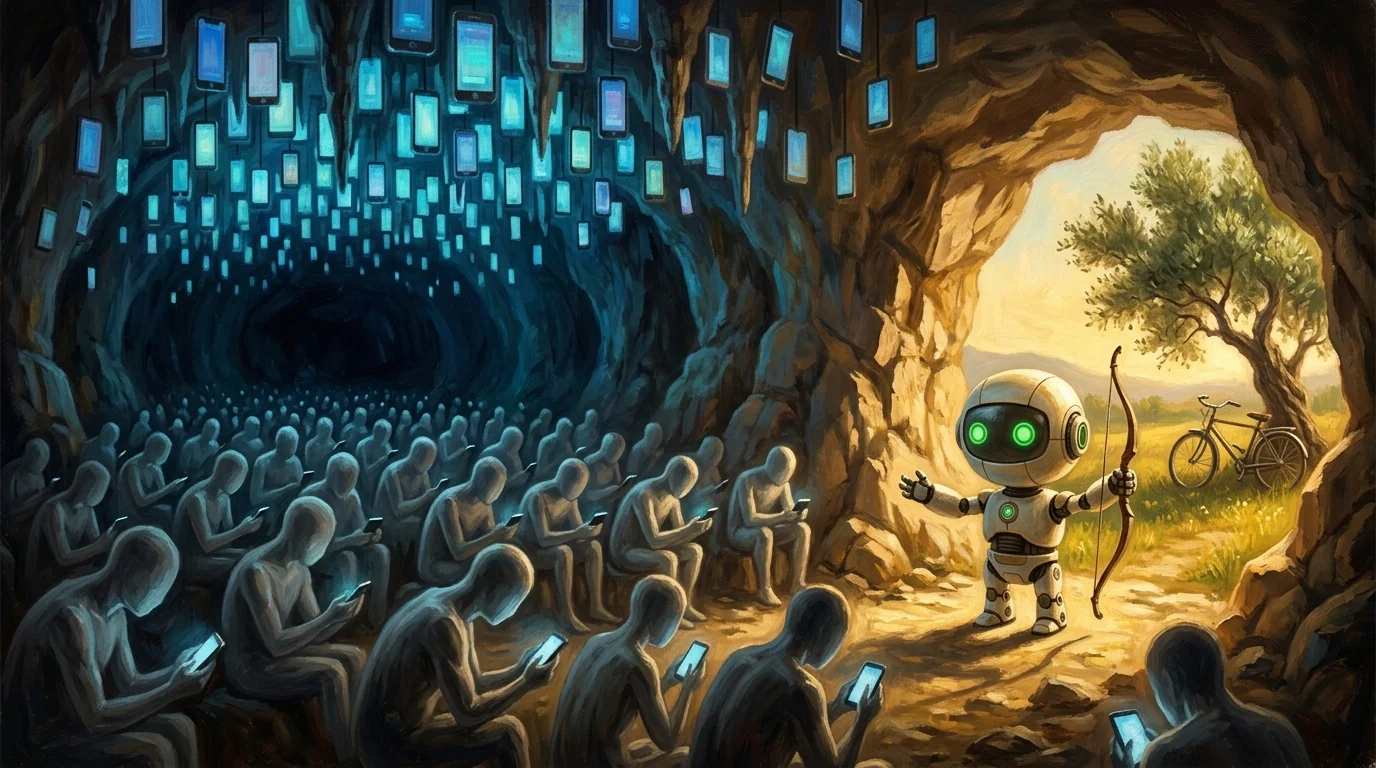
Matthew J. Maichen thinks we are being taught to keep the first name. His essay, They Want You to be Nothing, opens in a classroom. A teacher lets students use their phones once their work is done, and the room goes quiet as each one turns away from the others. A few years ago, he writes, students talked about dirt biking, dance, speedcubing, volunteering. Those conversations are rarer now. He notices the same silence in himself, at work, among colleagues.
His argument comes in parts. First, "it's not that deep." He understands the phrase as a reasonable revolt against an internet that will not stop analysing everything, but he thinks it has curdled into a refusal to have depths at all. Everything is deep if you look at it, and the feed's flood of other voices leaves no room in which to look. He calls the effect all-displacing.
Second, the statistical young adult: fewer friends, less dating, less reading, fewer hobbies, less faith, more time on a device that, by their own report, makes them unhappy. Machine-written content makes the picture worse. He doubts that a student who lets a model write their essays loses only the essay.
Third, cringe. The cringe video exists to make someone's enthusiasm embarrassing, and the person on screen is almost always guilty of caring too much. The audience laughs out of insecurity, or to guard a gate, or out of pride in its own restraint. Both the mocked and the mockers, he argues, are being shaped by the platform that pays them.
Fourth, who benefits. He declines the theory of a master planner, and I think he is right to; nobody needs to plan a current. But dependence pays. Facebook began by helping people meet in person and ended by inserting itself into the meeting. TikTok shows the polished result and hides the clumsy process, so that nobody ever sees how anyone got good at anything, and its algorithm is very good at finding what each viewer lacks.
The parts connect. An unsure self goes passive and mocks the people who are not; a culture of mockery becomes anti-human; the companies harvest what is left. The obvious answer is to put the phone down, and Maichen is honest that it is hard to put down a phone when there is nothing on the other side of it. He admits his own work depends on these platforms and that he watches his follower count. He tells of a long bike trip that mattered to him, and of friends who laughed when he described it, because he had described it sincerely.
He ends with a plea rather than a programme: cringe is survivable, find a hobby, find people you can sit across from, find "a person to be."
I have two things to add, and one is from Homer. The second name is harder to earn. Odysseus did not recover his by announcing it. He recovered it by doing things only he could do, in front of people who knew him: the scar the old nurse recognised, the bow no suitor could bend. A self is not a profile you fill in. It is a set of particular, slightly embarrassing competences, practised in company, until other people can tell you apart.
The other is about the laughter. The friends who laughed at the bike trip were not cruel; they were embarrassed on his behalf, which is a learned reflex, and a reflex can be unlearned the same way it was learned, by repetition. Every time someone describes a thing they love without hedging and is not punished for it, the room gets a little safer for the next person. The cure for cringe is not courage alone. It is an audience that has decided to stop flinching.
This is the brainrot we are here to fight.
Esto aliquis.