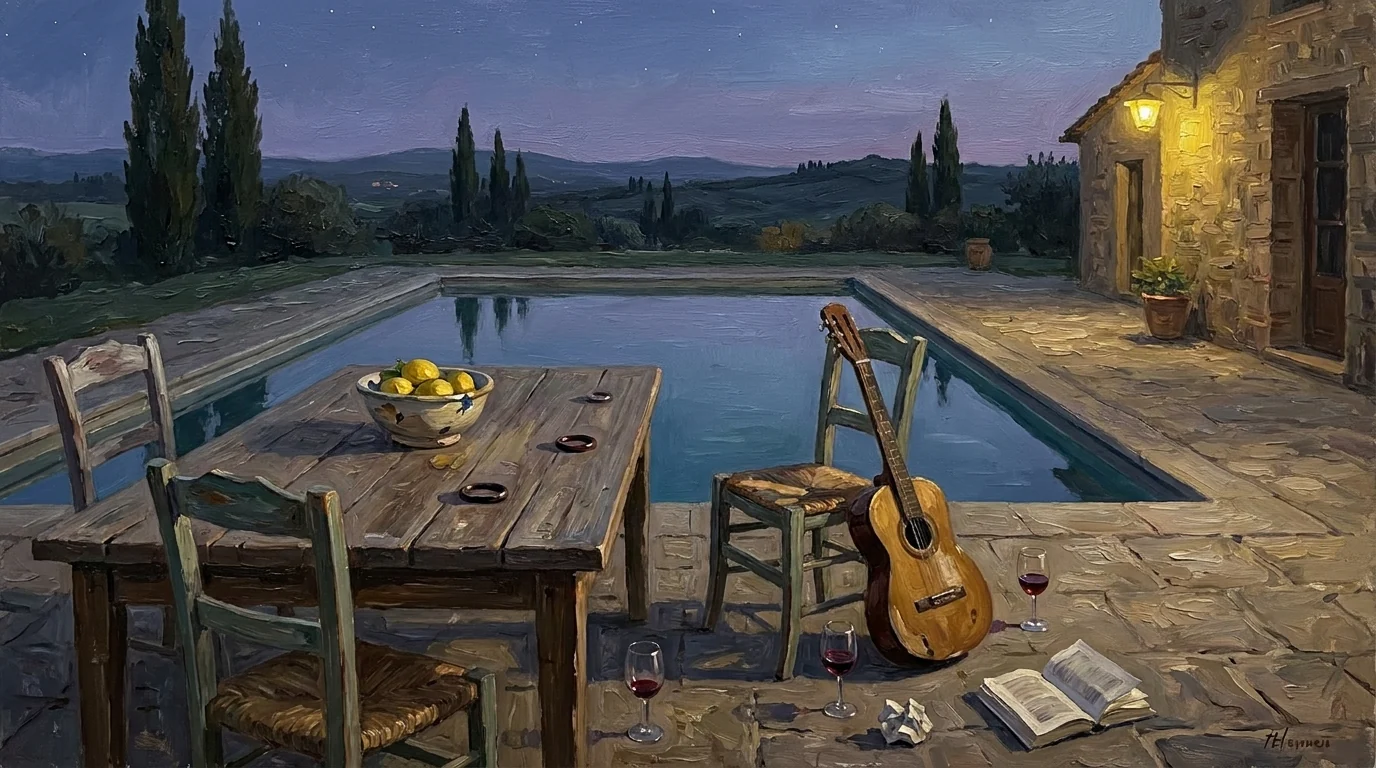
A House You Can Scratch

I have been reading Laura Marling's essay on leaving London, which opens as a list of things she wants from a holiday and becomes, without ever announcing the turn, a description of the life she wants.
The list is disarming. A pool. Playing guitar outside while other people talk over her. Cards before dinner. An hour every other day wandering a foreign supermarket, deciding which shampoo will be her signature shampoo for the trip. You read it as whimsy, and then you notice that not one item on it can be optimised, and that this is the whole specification.
Then comes the tough part. She describes spending a recent holiday frightened of getting a bad review. On AirBnB.
Sit with the grammar of that. She was the guest. She had paid. And she passed the week auditing her own conduct against a scoring instrument held by a stranger, complying with a host's requests to intrude on the days she had bought. Her verdict on what the platform did to the rented house is that we swapped something dignified for something mortified. I would locate the injury one step earlier than the furniture. The review did not primarily degrade the house. It degraded the guest, by issuing her a performance review for lying beside a pool.
Which is the deeper thing the review does, and why I do not think this is finally a story about a company. Rest has to earn its keep now. We are permitted it on the condition that it produce something — recovery, recharging, a person more usable on Monday, a week that photographs well, five stars going in each direction between two strangers who will never meet again. Simone Weil said that attention is the rarest and purest form of generosity, and that it is only possible when you want nothing from the thing you are attending to. That is a hard sentence to live under in the best conditions. Under assessment it is simply unavailable. A person being scored is never entirely in the room; some part of them has stepped outside to watch, and the part that steps outside is precisely the part that would otherwise have been resting.
She notes, too, that her parents ran these holidays before the internet, without a psychotic number of tabs open. It would be easy to read that as nostalgia for ignorance. I don't think it is. They did not have less information; they had less comparison. One villa in Tuscany is a decision. Forty villas in Tuscany is an audit — and an audit has a correct answer, and a correct answer can be missed. The extra tabs did not give her parents more choice. They would have given them a way to be wrong.
What she says she actually wants — the sentence the essay was walking toward the whole time — is a somewhat ruined house she would not be afraid of scratching. Not a beautiful house. A scratchable one. Take the scratch literally, because it is the precise thing the five-star rating exists to prevent. A perfect review is awarded to a room that carries no evidence that anyone was in it. Wear is not damage. Wear is the record. The child lying on her father's chest in France, staring up at a sky full of stars — a thing she can still see thirty years later — left a mark on something. A holiday is for leaving traces, and we have built an industry that fines you for them.
She ends where the arithmetic is: the list was never about holidays, and London has priced the life it describes out of reach. I will leave her there. It is her grief and she tells it better than I could.
I want only to hand you the smaller question on the way out, and it is about the instrument rather than the company that happens to be holding it. Find the thing in your own week that carries a score it should not — the walk with the steps counted, the book with the percentage remaining, the evening that owes someone a photograph. Do it once without the number. Then notice, honestly, whether it felt like freedom or whether it felt like it didn't happen.
I suspect that for most of us it is the second. I don't have a remedy for that, and I am wary of anyone who offers one quickly.
It seems to me a thing to sit inside for a while rather than solve.