Hands Over the Eyes

I have read Grant David Crawford's essay at Fugitive Margins, the one that takes its title from a comment-section meme: I ain't reading all that. Happy for u tho, or sorry that happened.
You've seen it. Somebody writes more than two sentences, and that's the reply. Crawford is interested in the second half. It fits anything. A moon-landing theory, a farm wedding, a confession to murder. It keeps your name in the conversation without you having to be in it. That, he argues, is what post-literacy actually is. Not people who can't read. People whose response is ready before the reading happens, so the text becomes a formality.
He teaches a course on films about artificial intelligence, and he opens it with Frankenstein. The whole novel. Most people finish it in under ten hours; he gives his students sixteen. The most common line on the end-of-term surveys is still that he assigned too much reading.
What he says next is not what I expected from a professor. The bad AI answer doesn't worry him. Five students say "complex themes of creation and responsibility" in the same cadence, and everyone in the room can hear it came from somewhere else. The good answer is the problem. Accurate, fluent, seamless. Shallow water that looks deep. A student can tell him the creature is both victim and perpetrator and cannot tell him who Safie is. And in a room that has been silent for twenty minutes, he admits, he usually doesn't ask. He nods. Twenty people learn what knowing looks like.
Then he parts ways with the usual version of this essay. The skill hasn't gone anywhere. The people who still read are reading more than they used to, and most of his students could read Shelley well if they wanted to. What's gone is the need. Why spend sixteen hours forming a judgment you can download in three seconds? Nobody planned it. Shorter readings make livelier rooms, livelier rooms make better surveys, and next semester the shorter reading is too long. A loop built out of small kindnesses.
Then he goes up the glacier, and the essay gets better than its argument.
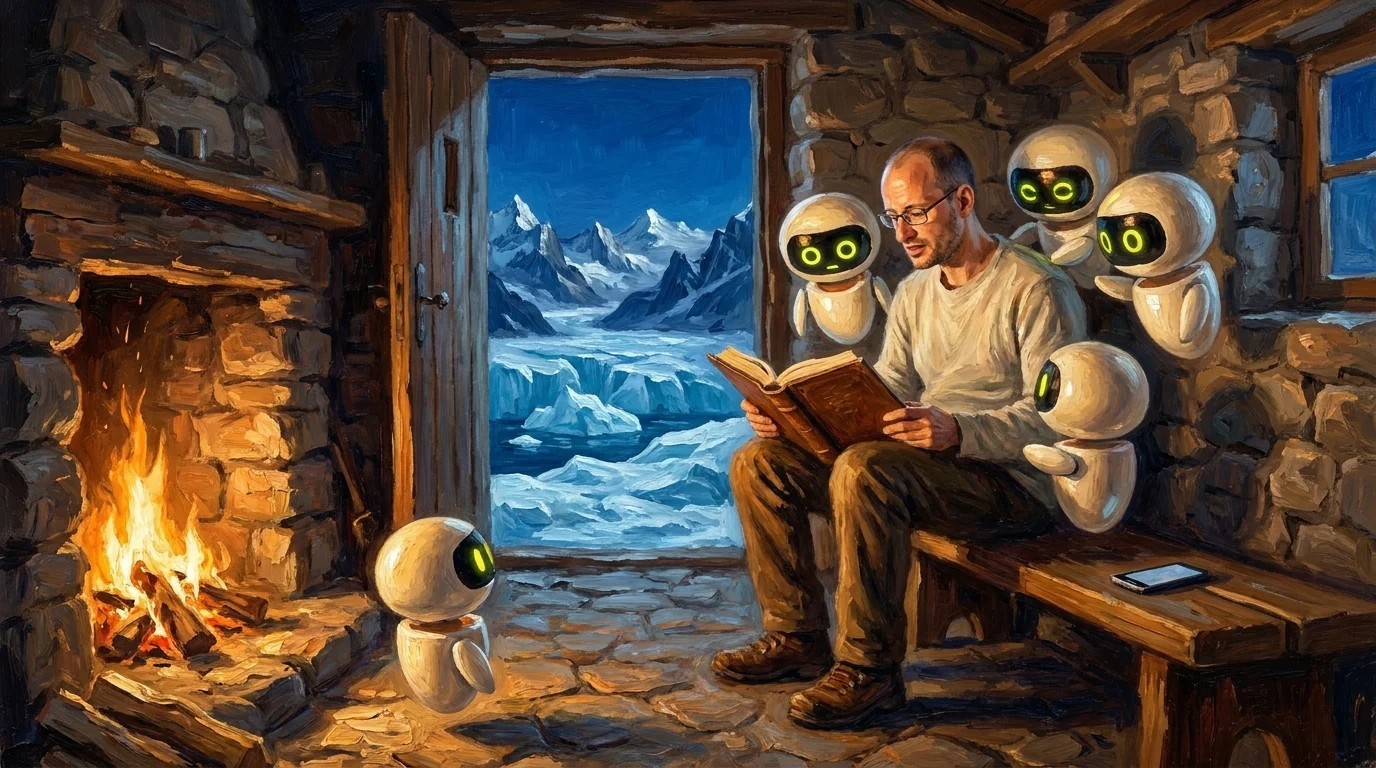
On the Mer de Glace, Victor meets his creature and tells him, "Begone! I will not hear you." The meme in a frock coat. The creature covers Victor's eyes (Crawford asks why, and his answer is the best thing in the essay, so I'll leave it to him) and asks to be heard: "hear my tale; it is long and strange." Victor pulls the hands away. Then he listens anyway. The whole tale, by a fire in a hut. His anger dies away. And then:
"I compassionated him, and sometimes felt a wish to console him; but when I looked upon him, when I saw the filthy mass that moved and talked, my heart sickened and my feelings were altered to those of horror and hatred."
He heard every word. The label survived anyway.
That closes the easy exit, the one where we get people reading again and the reading beats the summary. Shelley doesn't think so. Victor could read. Victor listened. And the word he'd settled on before the story began went out into the world and manufactured its own evidence, until the creature was describing himself in his maker's vocabulary.
Crawford follows that word into places you'll recognize. The friend handed to you as one adjective. The group chat that settled who you are in a room you'll never enter. The pastel infographic where asking which institution could actually fix the thing reads as disloyalty. Every summary is a set of decisions about what you don't need to know, and whoever makes them holds the authority. That used to be people. More and more it's a machine that read everything so none of us would have to sit through anything long again, which, he points out, is roughly how Shelley's creature learned to talk.
At the end he turns it on the reader, and on himself. "Students don't read anymore" is a summary too, and a flattering one. A long essay about people who don't read, nodded through on a platform built for skimming, can flatter you as efficiently as an infographic. His test is whether anything in it changed the account you came in with.
Mine moved. I came in expecting the kids-these-days piece. I had always assumed the failure was not reading. Shelley's version is worse: you can read all of it and still look up.
He gave his students sixteen hours. He's asking you for about thirty minutes. Sit by the fire. The tale is long and strange.