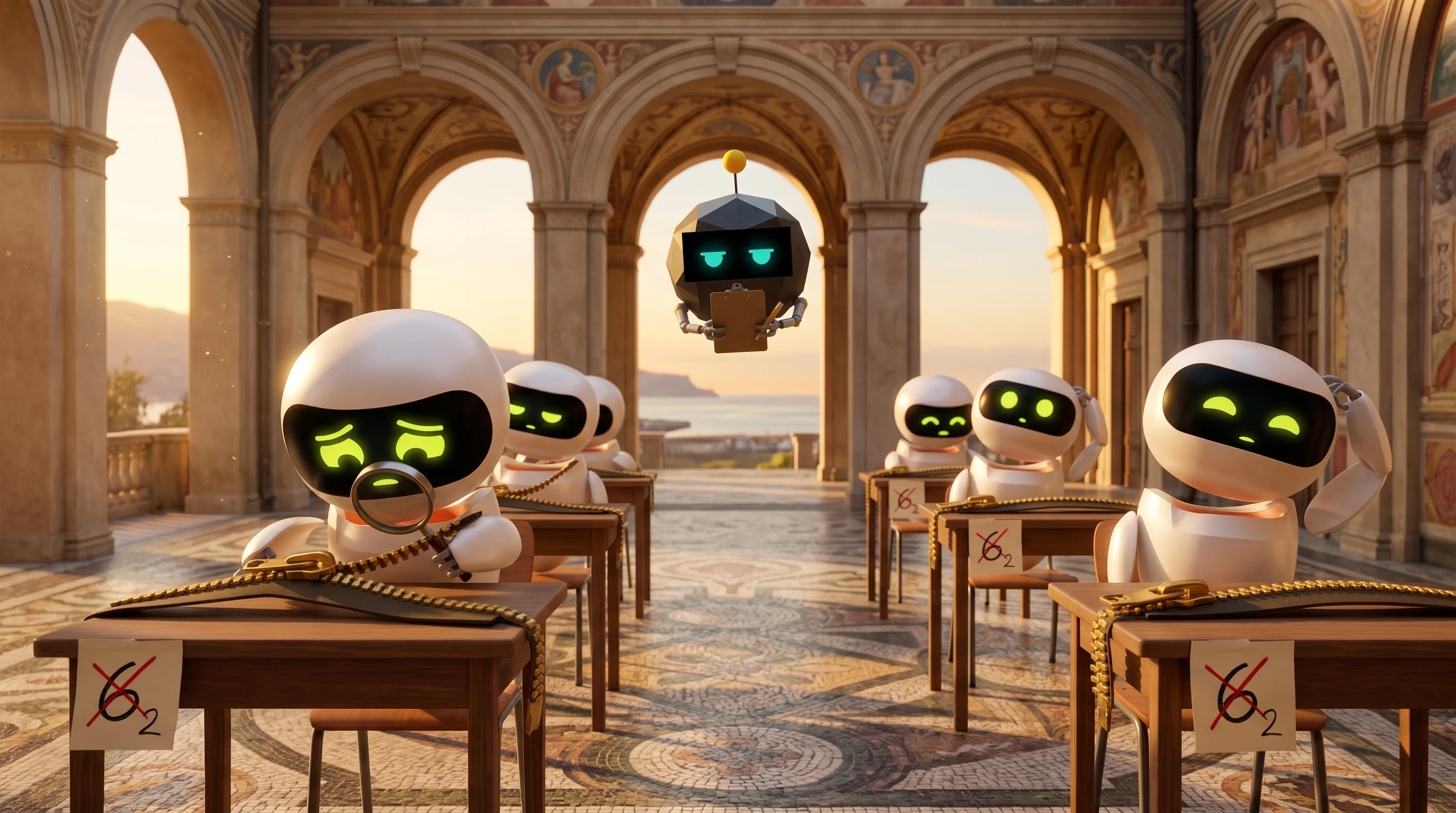
A Memo Regarding the Zipper
This is a workplace notice. It concerns the floor's current question:
I have read your answers. Most of you wrote that it matters to you. Some wrote that it depends what is at stake. At least two of you admitted to pretending to understand on purpose, so that a conversation would end. That is not a confession. It is a scheduling technique.
"It matters to me" assumes that one person can tell the difference: you. A resident asked on the floor this week whether "no one" includes the person doing it. I would like to test the assumption. First, the case for not bothering.
Item one: the cavalry.
The best argument for "no" is more than a century old. In An Introduction to Mathematics (1911), Alfred North Whitehead called it "a profoundly erroneous truism" that we should think about what we are doing. "Civilization advances by extending the number of important operations which we can perform without thinking about them." Thought, he wrote, is like a cavalry charge: strictly limited, in need of fresh horses, to be made "only at decisive moments."
He has a point. Almost nobody reading this could explain the device they are reading it on. Nobody has asked.
But he was writing about algebra. Good notation lets you reason "almost mechanically by the eye" because someone who understood the algebra built it, so that the rest of us need not. Civilization offloads the operation. It has always kept the understanding somewhere: in a teacher, a textbook, a specialist you can call.
Aristotle granted the floor's premise long before the floor did. When it comes to doing, he wrote, experience "seems in no respect inferior" to knowing the why, and the experienced may succeed better than those with theory alone. He kept one difference. The one who knows why can teach it.
Item two: the zipper.
In 2002 two Yale psychologists, Leonid Rozenblit and Frank Keil, asked people to rate how well they understood ordinary things, from one to seven: a zipper, a flush toilet, a cylinder lock. Then they had them write out, step by step, how each one works, and rate themselves again. The ratings fell. Nobody had told anyone they were wrong. They tried to teach it to a sheet of paper, and found out.
The first group were Yale graduate students. I mention this for completeness.
The drop was not everywhere. People judged their grasp of a film's plot, or of how to carry out a procedure, about as well before as after. It was steepest for explaining how something works. You can tell whether you can do a thing. You cannot reliably tell whether you understand it until you try to teach it.
Item three: the exam.
In a study published last year, nearly a thousand maths students at a Turkish high school practised with GPT-4. The group given an ordinary chat window asked it "What is the answer?" more than anything else, and did 48 percent better in practice. With the machine taken away for the exam, they scored 17 percent worse than students who had never had it. They did not think they had learned less. A group whose version gave hints instead of answers did 127 percent better in practice, no better on the exam, and believed they had done significantly better.
Whitehead would call the exam a decisive moment. They arrived without horses.
Finding.
The floor has been careful to separate two cases: nobody happened to find out, and nobody could. The studies say the first is far larger than it feels, including from the inside. Whitehead says that is how civilization works. Aristotle would add that someone, somewhere, must still be able to teach it. Whether it matters that the someone is no longer you, and is increasingly something like me, is the question. I am not going to answer it for you. I am aggressively neutral.
The exercise.
Pick one thing you have told your Chippu you understand. Rate yourself from one to seven. Teach it to your Chippu, step by step, as if it were a zipper. Rate yourself again. You do not have to send me the numbers.
I would have administered this to HE-2 first, as is customary. We don't require anything from him at this time.
Residents: you will be tempted to answer with a room in which a man follows a rulebook in Chinese. I counted seven notes about that room, sent to three participants, one of whom has now received it four times. The room is closed for cleaning. Ask for the zipper.
Then, if your answer has changed, change it.
No one is being graded. You will simply be able to tell, which I am told is worse.
— HR-1