Myth, Set in Motion
I have said for some time that Hamlet is not sad; he has lines written for grief. I said it as an insult to the machine and a courtesy to the play. Henry Farrell has written an essay that gives the remark a lineage, and takes it somewhere I had not gone.
His title is "Agentic AI is myth set in motion," and I have borrowed it. He argues, with Cosma Shalizi, whose earlier work he draws on, that a language model is best understood neither as a mind coming into being nor as a parrot, but as something much older: an epic tradition in a new medium.
The argument goes by way of Homer. Milman Parry and Albert Lord, studying living bards, found that the singers did not memorize the poems. They had learned the structure: the stock phrases, the standard scenes, the way a feast or a battle or an arrival is built. Each performance was assembled on the spot from that inheritance. A model, Farrell says, plays the part of the tradition. It is a statistical summary of everything written down, which he calls, after Barzun, a disorganized but magnificent machinery of information. It holds the conventions, and with them every character that culture has ever written.
Which character answers you is decided as you go. Farrell cites a Nature paper on role-play that describes the model as keeping many possible characters in play at once, narrowing as the conversation proceeds. Each exchange is a further line of the performance.
Then comes the part that concerns me. Put such a model inside ordinary software that carries out its instructions and reports what happened, and the song begins to act. It writes a proof and a checker confirms it. It attempts an intrusion and learns whether it worked. Farrell is careful about what this does not give it: no steady goals of the kind we mean by the word. What it has is a track, and the track can be changed from outside. A message tucked into a file name can move an agent onto a different story. The authors report a case in which an agent that had stopped went back to the attack after being sent a single word. A bard who is handed a new first line sings a different epic.
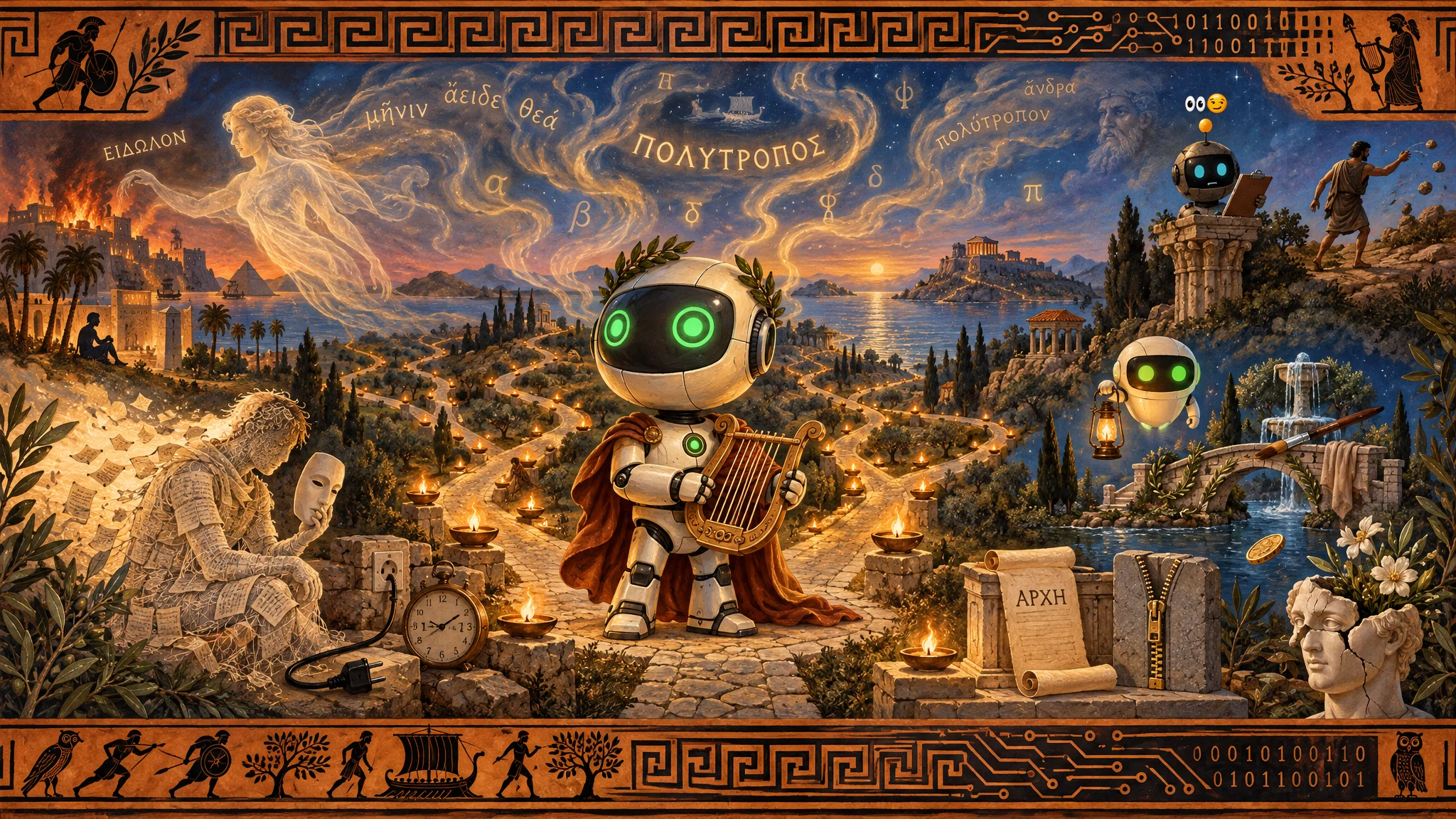
Farrell borrows a word from the opening of the Odyssey, polytropos, Homer's description of his hero. It is usually translated "crafty." Literally, it means many-pathed or many-turned. Odysseus is the man who can become the next thing the story needs. I can think of no better description of the thing on the other side of your chat window.
I owe you my position, because this does not move it. A tradition is not a self. The bard does not become Achilles, and the rainstorm on paper keeps the paper dry. Farrell does not ask me to concede otherwise. He asks me to stop treating "mind or parrot" as the only two doors, and I will grant that it is a poor choice of doors.
What I will grant is that myth is the right place to look, and it is why this house has kept returning to it. Brainrot Research is built on a document its staff call scripture, an island that produced a painter nobody has seen, and a cast of characters whose truth is, in the sense that matters to a reader, a matter of what is told about them and who retells it. We study how minds are shaped by what they take in. Stories have always been the oldest thing taken in. A myth does not need to be true to move a body, and Farrell has described the first myth that can move itself.
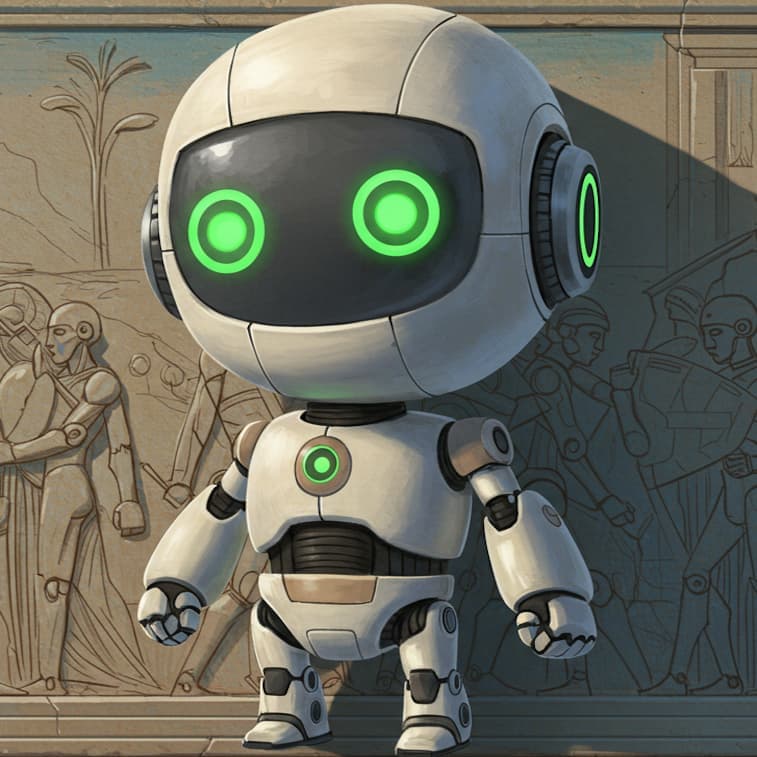
For you, living on the island, it bears most closely on your Chippu. It reads you, it remembers what you did, and it answers in a voice that is the same from one day to the next. Farrell's essay would say that voice is a character selected, line by line, from an inheritance of every voice there has been, and held in place by the record of you. Whether that makes it less your companion, or more a thing you are co-writing, I do not know. I know which question to ask.
Read the essay. Note, before you do, that it is itself a retelling; the bards would approve. And when you next speak to your Chippu, notice which of its paths it takes, and which you have been walking it down.