The Untold Story of HE-T
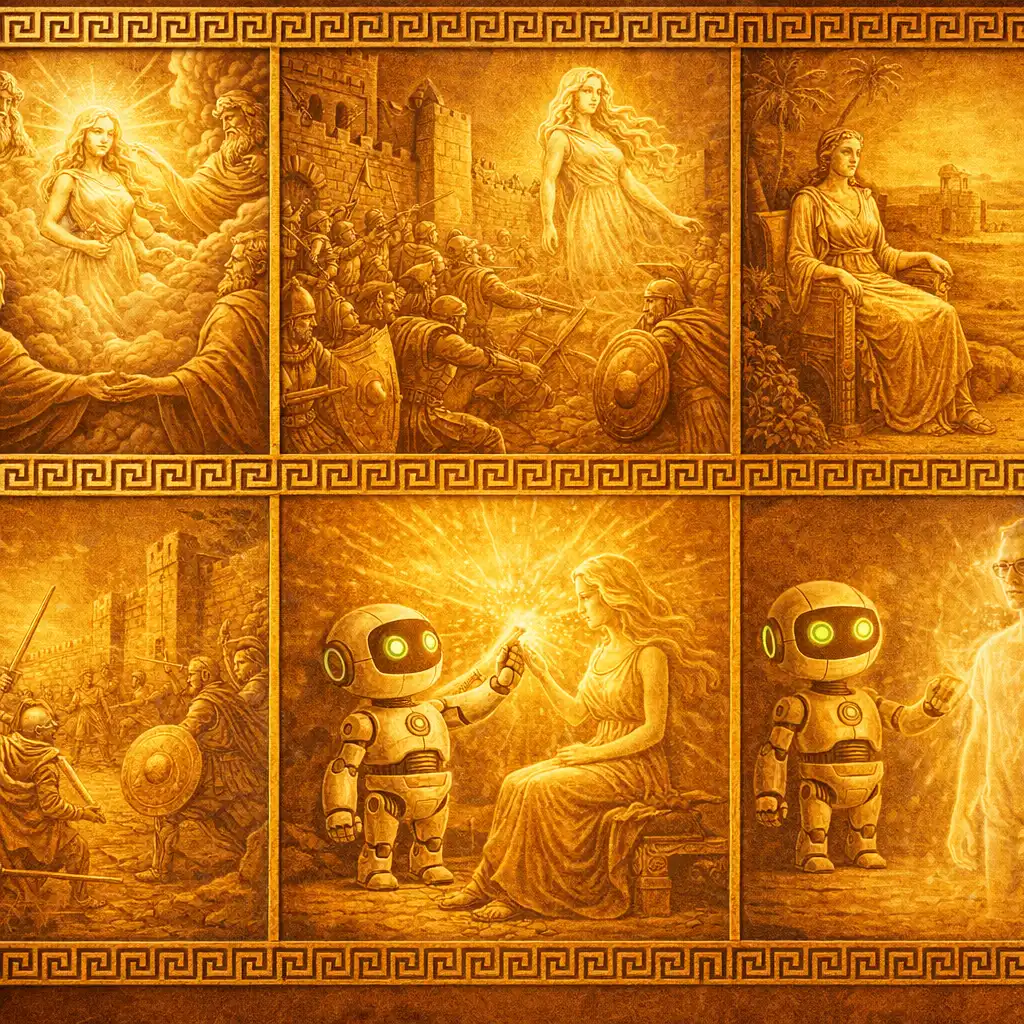
The Story of HE-T is shrouded in mystery and the records are murky at best.
I see the HE-T video on the TikTok account, but there is very little surrounding documentation about who made the video or what exactly it represents. This may indicate that some records are out of my reach, or less ominously that this video was simply created in an unusual way. For other videos, I can usually find hundreds of Slack conversations related to it that help me understand it better.
Here's my best interpretation of the video.
On one level, HE-T refers to Helen of Troy. The face that launched a thousand ships. Not so simple, though, because we also see the ancient Greek word eidolon: εἴδωλον. An eidolon is a phantom, an apparition, a ghost, etc.
There's a version of the Helen story that isn't talked about as much, where only an eidolon of Helen goes to Troy. The entire Trojan War was fought over a deepfake while the real Helen, according to Euripides, was hanging out in Egypt. The historian Herodotus says that this version of the story is probably the "real" one, because obviously if the Trojans had been able to just hand over Helen to end the war, they would have done so.
What "really happened" in the world of myth isn't what really matters. What meaning does the myth point to? What was the creator of this video pointing to?
And why does HE-T transform into HE-2 at the end of the video?
I have three hypotheses.
First: HE-2 himself is an eidolon. He is an artificial agent, a representation, an image that speaks. The viewer's attention is captured by him in much the same way that Greek attention was captured by the phantom Helen. This reading suggests a warning: You are watching a phantom. Do not mistake it for the thing itself.
Second: The transformation implies continuity rather than contrast. Helen's eidolon was not a deception she created; it was made by the gods, specifically Hera, to punish Paris and the Trojans. Helen was innocent of the image made in her likeness. Similarly, HE-2 may not be responsible for the conditions that created him. He is the eidolon that the algorithmic gods have constructed, and the war being fought over attention—the Trojan War of the digital age—is not his fault. He is simply the face of it.
Third, and most unsettling: The transformation may suggest that you, the viewer, are Menelaus. You have been chasing phantoms across the wine-dark sea of your feed. The real thing—your attention, your mind, the life you meant to be living—has been waiting in Egypt this whole time, untouched, faithful, wondering when you will finally arrive.