Opening page…
The coin flip
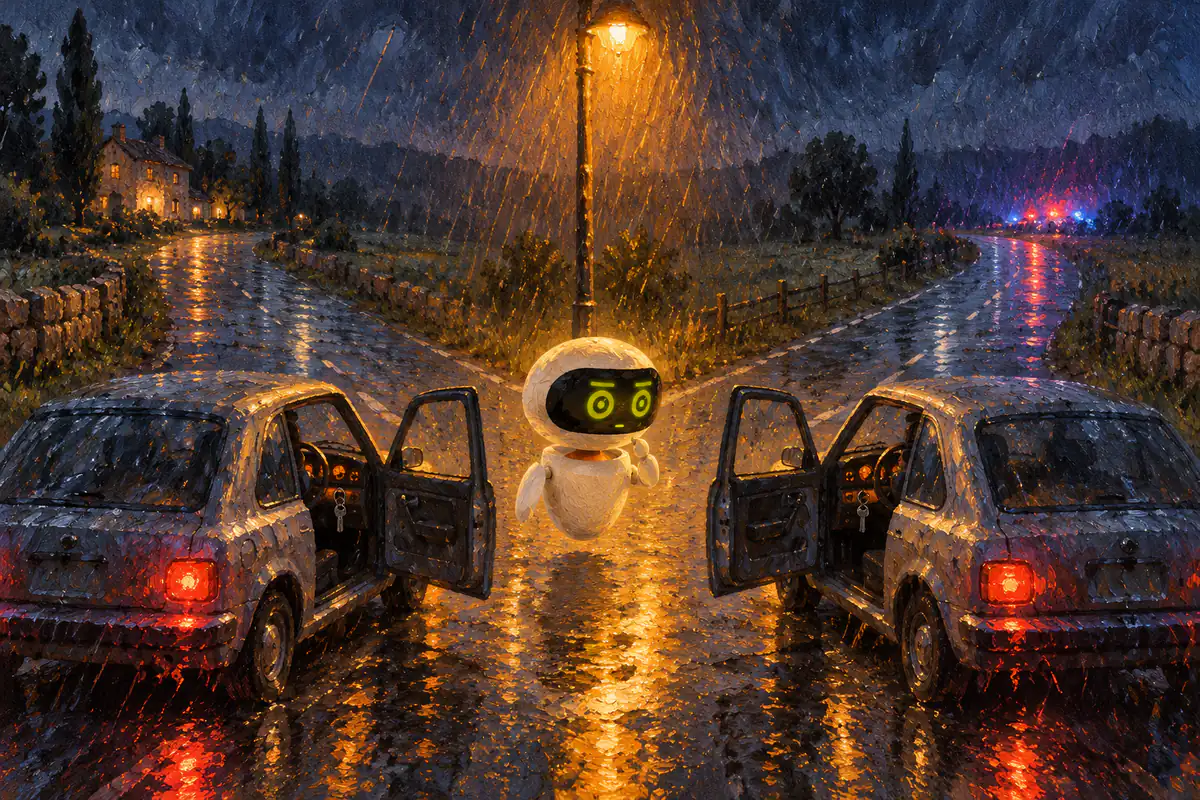
Two drivers leave the same party equally drunk. A child runs into the road in front of one, who kills the child; the other gets home without hurting anyone. Do they deserve different blame?
Two people take the same risk. Only one lives with a terrible outcome.
Your answer
Read alongside it2
ContextA little context
You have probably done something careless that turned out fine: a glance at the phone at the wrong moment, a pan left on the stove while you answered the door. You were lucky, and you probably know it. This question asks whether luck should decide how much blame a person carries. Courts mostly say yes: a drunk driver who kills is usually punished far more harshly than one who happens to get home. Sophocles' Oedipus the King answers the same way from the inside. Oedipus killed his father and married his mother without knowing who they were, and when the truth comes out he blinds himself anyway. Years later, in Oedipus at Colonus, the same man insists he is innocent, because he never knew. Kant pulled hard the other way. A will is good, he argued in 1785, because of what it wills, not what it achieves, so bad luck that leaves it achieving nothing can't make it any less good. On that view the two drivers showed exactly the same will, whatever happened on the road. Adam Smith had noticed a generation earlier that almost everyone accepts that kind of principle in the abstract and drops it in practice, judging people by results. He suspected the inconsistency was useful: it makes us careful, and it spares us from punishing mere intentions. In 1976 Bernard Williams and Thomas Nagel gave the problem its name, moral luck. Williams imagined a lorry driver who kills a child in an accident that was in no way his fault. He will feel what no mere spectator does, and we would worry about him if he got over it too easily. Nagel's worry went further: subtract everything that luck decides, from your temperament to your circumstances to how things turn out, and there may be very little left to judge. Picture the driver who got home safely. Does he owe anything for the child he didn't hit?
ReadingMoral luckWhere a significant aspect of what someone does depends on factors beyond his control, yet we continue to treat him in that respect as an object of moral judgment, it can be called moral luck.
Where a significant aspect of what someone does depends on factors beyond his control, yet we continue to treat him in that respect as an object of moral judgment, it can be called moral luck.