Opening page…
Whose fault is the scroll?
If an app is built so that you can't put it down, whose fault is it when you can't?
Designers study what keeps you watching. Ask how responsibility divides between the people who build for compulsion and the person who keeps choosing it.
Your answer
Read alongside it1
ContextA little context
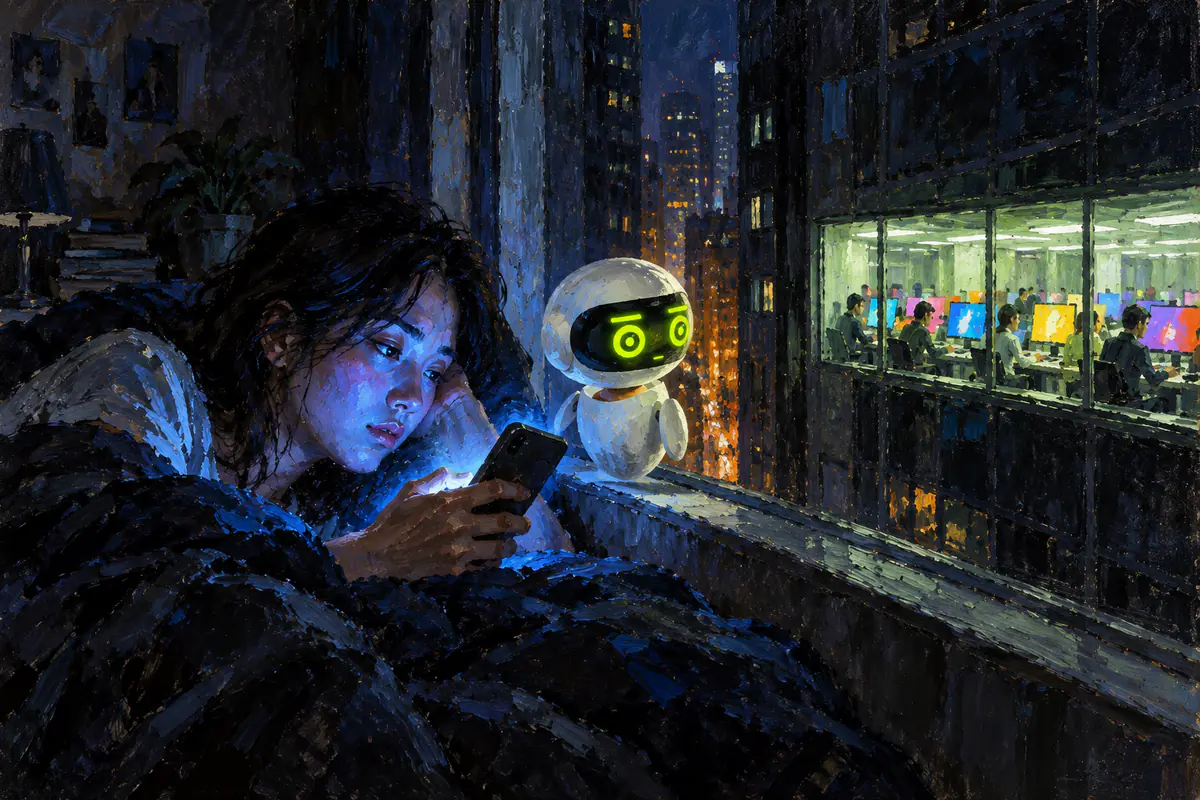
You open the app to check one thing. Forty minutes later you surface with no memory of deciding to stay. Afterward you feel two things at once: that you wasted the time, and that it was taken from you. Aristotle would not have let you off. Character, he argued, is built out of what we choose to do, so we answer even for the habits that later seem to rule us; he cited with approval lawgivers who punished offenses committed drunk more heavily, since getting drunk had been up to the drinker. Pascal located the trouble deeper still. In his Pensées he argued that people can hardly bear to be alone with their own thoughts, so they chase diversion, and will take almost any distraction over quiet. The other side of the ledger is design. In the 1950s B. F. Skinner found that pigeons pecked most persistently when rewards arrived on an unpredictable schedule, the principle that keeps people at slot machines. The anthropologist Natasha Dow Schüll, studying machine gamblers for Addiction by Design (2012), found the industry tuning its machines to hold players in what the players themselves called the zone. And the engineer who invented pull-to-refresh has said he came to see the gesture as addictive. David Foster Wallace took the idea to its end in Infinite Jest (1996). The novel turns on a film so entertaining that anyone who sees it wants nothing but to keep watching, until they die, and the plot treats it less as a product than as a weapon. When you lose an evening to a feed, how much of it was your choice, and how much was someone else's?